 Add to Chrome
 Add to Firefox
 Add to Edge
Adaptive Auto-Harness: Sustained Self-Improvement for Agentic System Deployment on Open-Ended Task Streams
Jun 01, 2026
Auto-harness systems such as A-Evolve, GEPA, and Meta-Harness improve LLM agents by optimizing prompts, skills, tools, memories, and supporting infrastructure from execution feedback, but they are typically evaluated on fixed offline benchmarks. Real deployments instead present open-ended task streams: histories grow without a fixed endpoint, heterogeneous tasks require different harnesses, and problem distributions shift over time. These challenges make a single repeatedly and densely updated harness brittle, causing performance degradation as accuracy peaks early and then declines. This motivates sustained harness construction with task-wise adaptation. We introduce Adaptive Auto-Harness, a framework and system for such streams. The framework decomposes the gap to an oracle harness into evolution loss and adaptation loss. The system addresses these losses with a stateful multi-agent evolver, a harness tree with solve-time routing, and human-steering hooks for cases where history lacks the needed signal. Across prediction-market, security-competition, and event-forecasting streams, Adaptive Auto-Harness outperforms five existing auto-harness baselines and ablations attribute gains to better construction, routing, or targeted human steering. Code is available in https://github.com/A-EVO-Lab/AdaptiveHarness .

Harness Updating Is Not Harness Benefit: Disentangling Evolution Capabilities in Self-Evolving LLM Agents
May 28, 2026LLM agents are increasingly deployed as systems built around editable external harnesses, including prompts, skills, memories and tools, that shape task execution without changing model parameters. Harness self-evolution adapts such agents by updating these harnesses from execution evidence. Yet it remains unclear whether a model's base capability in task-solving predicts its capabilities in harness self-evolution: which models produce useful harness updates, and which actually benefit from them? We analyze two harness self-evolution capabilities: (i) harness-updating, the capability to produce useful persistent harness updates from execution evidence; (ii) harness-benefit, the capability to benefit from updated harnesses during task solving. Our analysis reveals two findings. First, harness-updating is flat in base capability: models from different capability tiers produce harness updates that lead to surprisingly similar gains; even Qwen3.5-9B's updates yield gains comparable to those of Claude Opus~4.6. Second, harness-benefit is non-monotonic in base capability: weak-tier models benefit little from updated harnesses, mid-tier models benefit most, and strong-tier models benefit less than mid-tier. We trace low gains at the weak tier to two failure modes: weak-tier models may fail to activate relevant harness artifacts, or activate them but fail to follow them faithfully. These findings suggest investing capability budget in the task-solving agent rather than the evolver, and targeting harness invocation and long-horizon instruction following in agent training. Our source code is publicly available at https://github.com/A-EVO-Lab/a-evolve/tree/release/harness-evolution.
From Seeing to Thinking: Decoupling Perception and Reasoning Improves Post-Training of Vision-Language Models
May 19, 2026Recent advances in vision-language models (VLMs) emphasize long chain-of-thought reasoning; yet, we find that their performance on visual tasks is primarily limited by a lack of visual perception as opposed to reasoning itself. In this work, we systematically study the interplay between perception and reasoning in VLM post-training by decomposing their capabilities into three separate training stages: visual perception, visual reasoning, and textual reasoning, incorporating specialized training data. We demonstrate that visual perception (a) requires targeted optimization with specialized data; (b) serves as a fundamental scaffold that should be solidified through staged training before refining visual reasoning; and (c) is more effectively learned via RL than caption-based SFT. Our experiments across multiple VLMs demonstrate that staged training consistently improves both visual perception and reasoning performance over merged training. Notably, models trained with our approach achieve 1.5% higher reasoning accuracy with 20.8% shorter reasoning traces, suggesting that superior perception reduces the need for excessive reasoning. Furthermore, we show that this capability-based staging represents a new curriculum dimension orthogonal to traditional difficulty-based curricula, and combining both yields further additive gains. Our staged-training models achieve superior performance among open-weight VLMs, establishing advanced results on several visual math and perception (e.g., +5.2% on WeMath and +3.7% on RealWorldQA) tasks compared with the base counterpart.
MemMA: Coordinating the Memory Cycle through Multi-Agent Reasoning and In-Situ Self-Evolution
Mar 19, 2026Memory-augmented LLM agents maintain external memory banks to support long-horizon interaction, yet most existing systems treat construction, retrieval, and utilization as isolated subroutines. This creates two coupled challenges: strategic blindness on the forward path of the memory cycle, where construction and retrieval are driven by local heuristics rather than explicit strategic reasoning, and sparse, delayed supervision on the backward path, where downstream failures rarely translate into direct repairs of the memory bank. To address these challenges, we propose MemMA, a plug-and-play multi-agent framework that coordinates the memory cycle along both the forward and backward paths. On the forward path, a Meta-Thinker produces structured guidance that steers a Memory Manager during construction and directs a Query Reasoner during iterative retrieval. On the backward path, MemMA introduces in-situ self-evolving memory construction, which synthesizes probe QA pairs, verifies the current memory, and converts failures into repair actions before the memory is finalized. Extensive experiments on LoCoMo show that MemMA consistently outperforms existing baselines across multiple LLM backbones and improves three different storage backends in a plug-and-play manner. Our code is publicly available at https://github.com/ventr1c/memma.
Position: Agentic Evolution is the Path to Evolving LLMs
Jan 30, 2026As Large Language Models (LLMs) move from curated training sets into open-ended real-world environments, a fundamental limitation emerges: static training cannot keep pace with continual deployment environment change. Scaling training-time and inference-time compute improves static capability but does not close this train-deploy gap. We argue that addressing this limitation requires a new scaling axis-evolution. Existing deployment-time adaptation methods, whether parametric fine-tuning or heuristic memory accumulation, lack the strategic agency needed to diagnose failures and produce durable improvements. Our position is that agentic evolution represents the inevitable future of LLM adaptation, elevating evolution itself from a fixed pipeline to an autonomous evolver agent. We instantiate this vision in a general framework, A-Evolve, which treats deployment-time improvement as a deliberate, goal-directed optimization process over persistent system state. We further propose the evolution-scaling hypothesis: the capacity for adaptation scales with the compute allocated to evolution, positioning agentic evolution as a scalable path toward sustained, open-ended adaptation in the real world.
Trajectory2Task: Training Robust Tool-Calling Agents with Synthesized Yet Verifiable Data for Complex User Intents
Jan 28, 2026Tool-calling agents are increasingly deployed in real-world customer-facing workflows. Yet most studies on tool-calling agents focus on idealized settings with general, fixed, and well-specified tasks. In real-world applications, user requests are often (1) ambiguous, (2) changing over time, or (3) infeasible due to policy constraints, and training and evaluation data that cover these diverse, complex interaction patterns remain under-represented. To bridge the gap, we present Trajectory2Task, a verifiable data generation pipeline for studying tool use at scale under three realistic user scenarios: ambiguous intent, changing intent, and infeasible intents. The pipeline first conducts multi-turn exploration to produce valid tool-call trajectories. It then converts these trajectories into user-facing tasks with controlled intent adaptations. This process yields verifiable task that support closed-loop evaluation and training. We benchmark seven state-of-the-art LLMs on the generated complex user scenario tasks and observe frequent failures. Finally, using successful trajectories obtained from task rollouts, we fine-tune lightweight LLMs and find consistent improvements across all three conditions, along with better generalization to unseen tool-use domains, indicating stronger general tool-calling ability.
TRAJECT-Bench:A Trajectory-Aware Benchmark for Evaluating Agentic Tool Use
Oct 06, 2025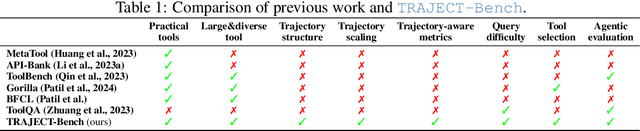
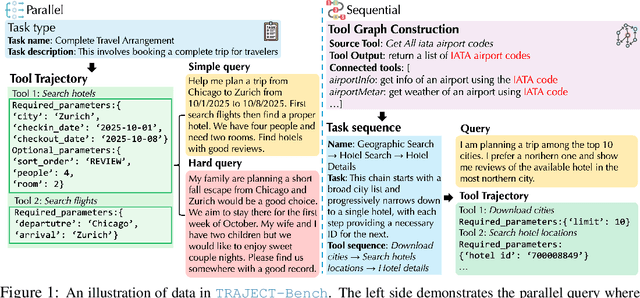
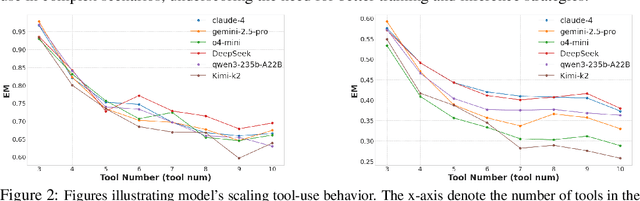
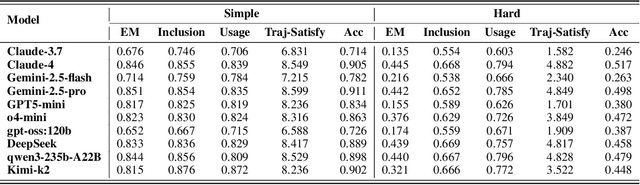
Large language model (LLM)-based agents increasingly rely on tool use to complete real-world tasks. While existing works evaluate the LLMs' tool use capability, they largely focus on the final answers yet overlook the detailed tool usage trajectory, i.e., whether tools are selected, parameterized, and ordered correctly. We introduce TRAJECT-Bench, a trajectory-aware benchmark to comprehensively evaluate LLMs' tool use capability through diverse tasks with fine-grained evaluation metrics. TRAJECT-Bench pairs high-fidelity, executable tools across practical domains with tasks grounded in production-style APIs, and synthesizes trajectories that vary in breadth (parallel calls) and depth (interdependent chains). Besides final accuracy, TRAJECT-Bench also reports trajectory-level diagnostics, including tool selection and argument correctness, and dependency/order satisfaction. Analyses reveal failure modes such as similar tool confusion and parameter-blind selection, and scaling behavior with tool diversity and trajectory length where the bottleneck of transiting from short to mid-length trajectories is revealed, offering actionable guidance for LLMs' tool use.
Towards Context-Robust LLMs: A Gated Representation Fine-tuning Approach
Feb 22, 2025Large Language Models (LLMs) enhanced with external contexts, such as through retrieval-augmented generation (RAG), often face challenges in handling imperfect evidence. They tend to over-rely on external knowledge, making them vulnerable to misleading and unhelpful contexts. To address this, we propose the concept of context-robust LLMs, which can effectively balance internal knowledge with external context, similar to human cognitive processes. Specifically, context-robust LLMs should rely on external context only when lacking internal knowledge, identify contradictions between internal and external knowledge, and disregard unhelpful contexts. To achieve this goal, we introduce Grft, a lightweight and plug-and-play gated representation fine-tuning approach. Grft consists of two key components: a gating mechanism to detect and filter problematic inputs, and low-rank representation adapters to adjust hidden representations. By training a lightweight intervention function with only 0.0004\% of model size on fewer than 200 examples, Grft can effectively adapt LLMs towards context-robust behaviors.
Towards Knowledge Checking in Retrieval-augmented Generation: A Representation Perspective
Nov 21, 2024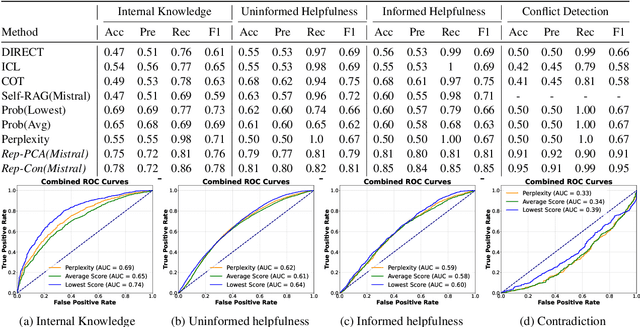
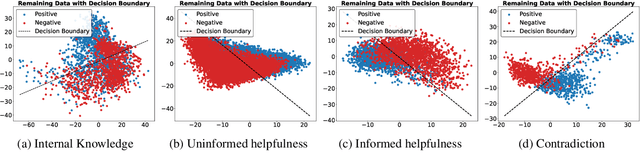
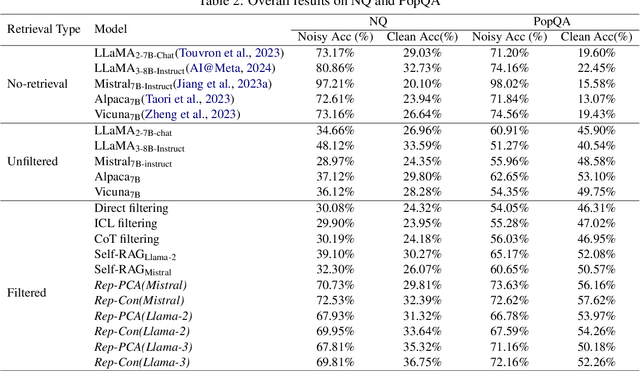
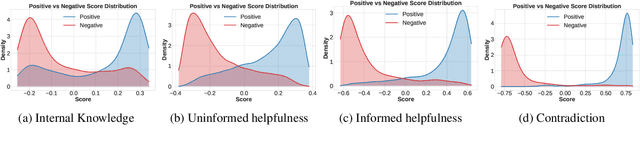
Retrieval-Augmented Generation (RAG) systems have shown promise in enhancing the performance of Large Language Models (LLMs). However, these systems face challenges in effectively integrating external knowledge with the LLM's internal knowledge, often leading to issues with misleading or unhelpful information. This work aims to provide a systematic study on knowledge checking in RAG systems. We conduct a comprehensive analysis of LLM representation behaviors and demonstrate the significance of using representations in knowledge checking. Motivated by the findings, we further develop representation-based classifiers for knowledge filtering. We show substantial improvements in RAG performance, even when dealing with noisy knowledge databases. Our study provides new insights into leveraging LLM representations for enhancing the reliability and effectiveness of RAG systems.
Exploring Query Understanding for Amazon Product Search
Aug 05, 2024


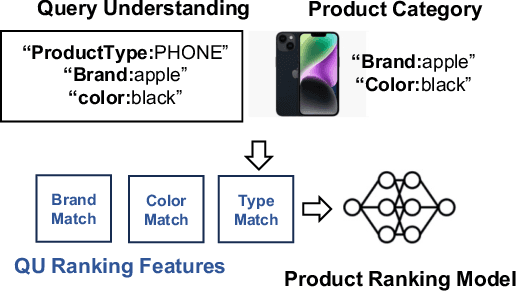
Online shopping platforms, such as Amazon, offer services to billions of people worldwide. Unlike web search or other search engines, product search engines have their unique characteristics, primarily featuring short queries which are mostly a combination of product attributes and structured product search space. The uniqueness of product search underscores the crucial importance of the query understanding component. However, there are limited studies focusing on exploring this impact within real-world product search engines. In this work, we aim to bridge this gap by conducting a comprehensive study and sharing our year-long journey investigating how the query understanding service impacts Amazon Product Search. Firstly, we explore how query understanding-based ranking features influence the ranking process. Next, we delve into how the query understanding system contributes to understanding the performance of a ranking model. Building on the insights gained from our study on the evaluation of the query understanding-based ranking model, we propose a query understanding-based multi-task learning framework for ranking. We present our studies and investigations using the real-world system on Amazon Search.